
Pilot vs Prototype: Designing a CaelumOne DMS-ECM Pilot That Proves Compliance
In regulated manufacturing, an enterprise content management pilot cannot simply mean testing whether documents can be scanned, uploaded, searched, or routed through a basic workflow.
Those functions may demonstrate that the technology works, but they do not prove that the organisation can govern regulated information under production conditions.
A compliance-grade Document Management and Enterprise Content Management (DMS-ECM) pilot using a system like CaelumOne DMS-ECM must demonstrate something more important: That document and records governance operates consistently, securely, and audibly throughout the information lifecycle.
The distinction is fundamental to the success of the implementation. Find out more today on the recoimmended path forward by reading our blog post today.
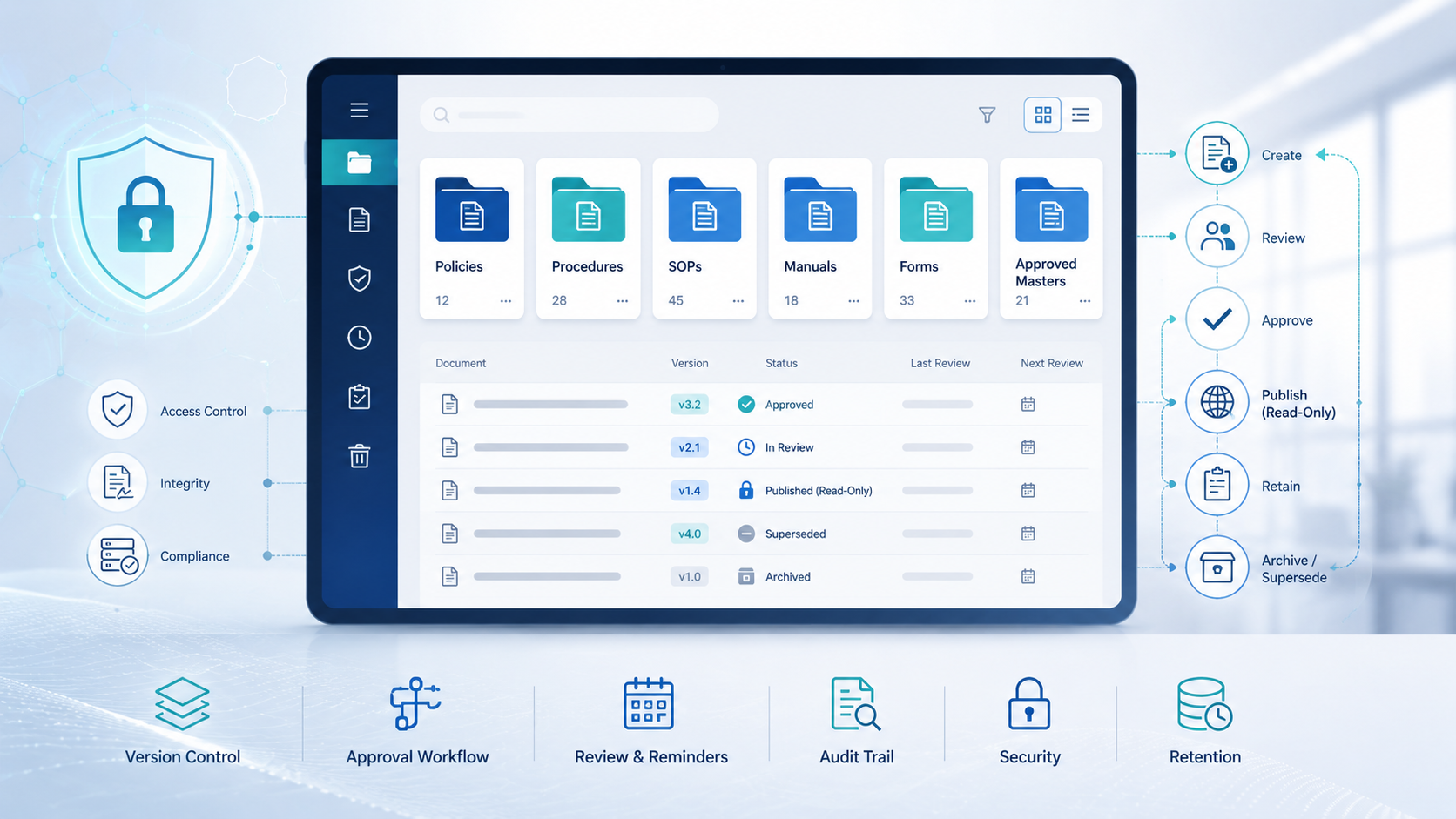
Controlled Documents Best Practices: Managing Policies, Procedures, SOPs, Manuals, Forms, and Approved Masters
In regulated environments especially, controlled documents are not simply files stored in a shared folder. They are business-critical records that require formal ownership, approval, publication, version control, audit history, review cycles, retention, and controlled access.
CaelumOne Document Management and Enterprise Content Management (DMS-ECM) helps organisations manage controlled documents through secure version control, workflow approvals, role-based permissions, audit trails, retention rules, metadata, and read-only publication. Find out more today in our current blog post.

Records Governance Evaluation Guide: Assessing Risk, Retention, Access, Auditability, and Defensible Disposition
Strong records governance ensures that records are retained for the right period, accessible to the right people, protected from unauthorized access, and disposed of only when legally and operationally appropriate.
It also creates the foundation for broader digital transformation. Organisations that want to improve disclosure readiness, reduce audit preparation time, support privacy obligations, or introduce AI-enabled content retrieval need governed, classified, searchable, and auditable records first. CaelumOne Solutions Corporation welcomes the opportunity to assist in creating the proper governance structure for your documentation. Contact us today.
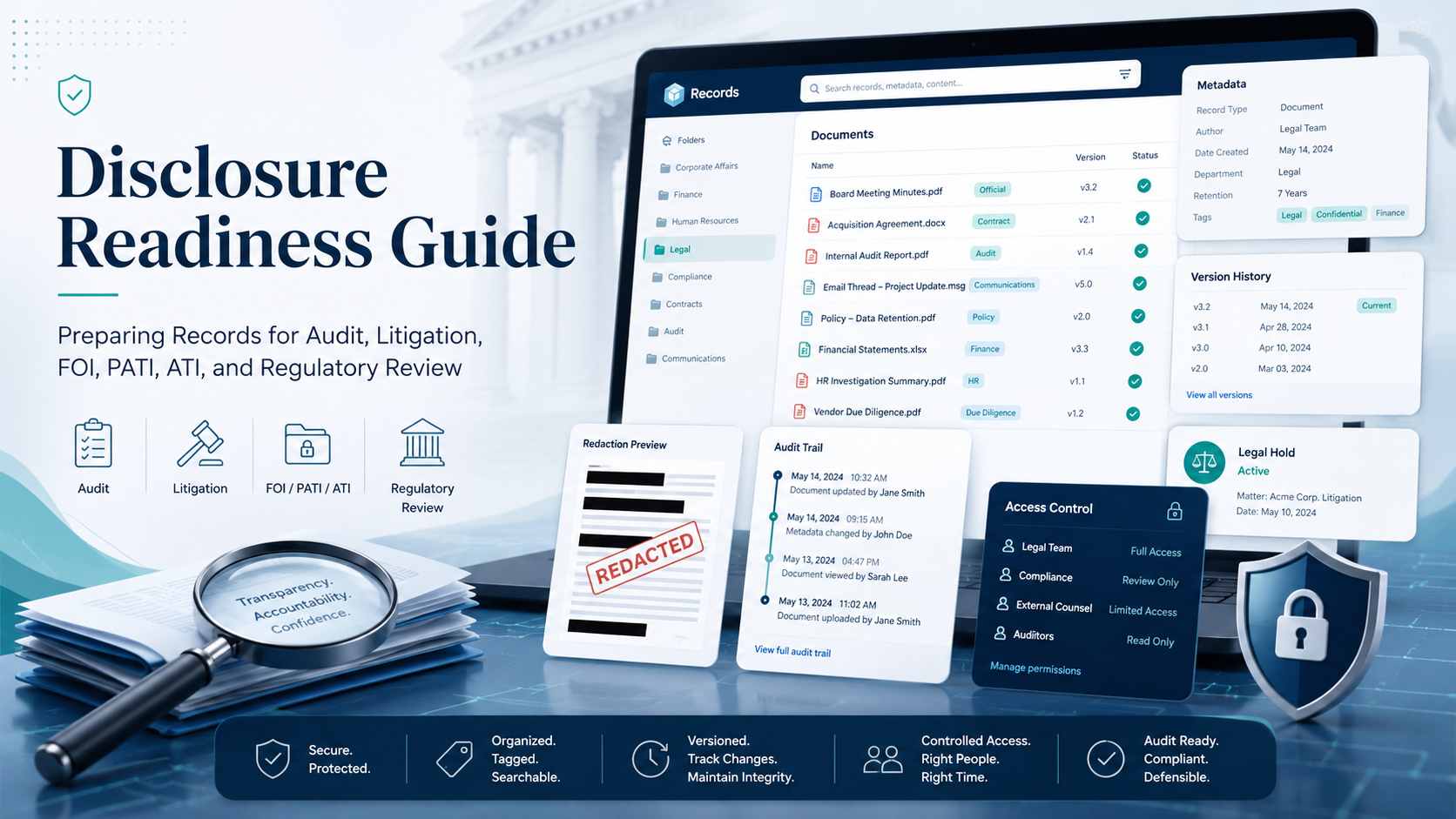
Disclosure Readiness Guide: Preparing Records for Audit, Litigation, FOI, PATI, ATI, and Regulatory Review
Disclosure events are rarely convenient. They often arise under strict timelines, external scrutiny, and legal or regulatory pressure. In many cases, the organisation must demonstrate not only that records were produced, but that the process used to locate, review, protect, redact, and disclose those records was complete, consistent, and defensible.
Organisations that rely heavily on paper files, unmanaged shared drives, email attachments, or disconnected systems may struggle to answer basic disclosure. Find out more today on our Disclosure Readiness Blog Post.

DMS-ECM Readiness Checklist: Is Your Organisation Ready for Modern Document Governance?
For many organisations, the need for Document Management and Enterprise Content Management (DMS-ECM) does not appear all at once. It builds gradually through growing document volumes, inconsistent filing practices, retrieval delays, audit pressure, version control issues, and increasing compliance obligations. By the time it becomes evident that a DMS-ECM platform is needed your staff are already buried in manual processes handling documentation requirements. Use this readiness checklist to validate whether your firm is ready to begin the digital transformation to the CaelumOne DMS-ECM today.

Why Retention and Defensible Disposition Matter More Than Ever
Retention and defensible disposition matter because information risk does not end once a document is stored.
Records must be retained for the right period, protected when subject to legal hold, reviewed before disposition, and destroyed only when authorised and defensible. Manual business practices alone are no longer enough for organisations operating in regulated or evidence-driven environments. Find out more about how CaelumOne DMS-ECM can help our clients move beyond simply storing data to true document governance during a documents entire lifecycle.

Data Residency vs Data Sovereignty: What Regulated Organisations Need to Understand
Data residency and data sovereignty are connected, but they are not interchangeable.
Data residency is about where information is stored.
Data sovereignty is about who has legal, operational, and administrative control over that information.
Read our new blog post to find out more about the differences between the two.

Safe AI Starts With Governed Content
Many organisations are exploring AI-powered search, natural language retrieval, summarisation, and knowledge discovery. These capabilities can be valuable, especially where staff must navigate large volumes of policies, procedures, contracts, case files, customer records, drawings, correspondence, or compliance evidence. The problem occurs when AI includes unmanaged content. The challenge is not simply whether AI can retrieve information. The challenge is whether it is retrieving the right information, from the right source, under the right controls.

AI Readiness Checklist for Regulated Organisations
For organisations operating under audit, disclosure, quality, privacy, or records-management obligations, AI readiness is not simply a technology question. It is a governance question.
Before AI can be safely introduced, the organisation must understand whether its documents, records, metadata, permissions, versions, audit trails, and retention rules are sufficiently controlled. Read our blog and find out more about how to plan for implementing an AI layer on your data properly today.

Why ‘Retention’ Without Automation Is a Compliance Liability
Most organisations have retention schedules.
Unfortunately, few enforce them consistently.
This is where risk quietly accumulates.
Retention policies written in a binder — or stored in a PDF — do not protect an organisation. They must be applied automatically and consistently across systems.

Disposition Done Wrong: How “Good Intentions” Create Compliance Failures
Document Disposition—defensible destruction—is a compliance requirement in many jurisdictions. Yet it is often approached as an administrative clean-up exercise.
This is where well-intentioned actions can create the largest risk.

Controlled Documents: The Difference Between “Latest” and “Approved”
In regulated manufacturing the latest document is not necessarily the approved document!
Find out more about defensible controlled-document models using our CaelumOne DMS-ECM Software Solution!

Microsoft 365 Isn’t a Records Strategy
Many financial institutions have embraced Microsoft 365 for collaboration and productivity. Teams, SharePoint, OneDrive, Outlook—these tools move work faster.
However, in regulated financial services, speed is not the only requirement. Defensibility is.

AI Does Not Replace DMS-ECM — Instead It Exposes Weak DMS-ECM Platforms!
Artificial Intelligence is rapidly being layered on top of document management and enterprise content management systems (DMS-ECM).
Chat interfaces. Copilots. Semantic search. Automated summarization.
Yet many organisations are discovering something uncomfortable:
AI does not fix information chaos. It amplifies it.

Data Residency vs Data Sovereignty: Why the Distinction Matters
“Where is the data stored?” is no longer the full question.
In regulated markets, organisations increasingly ask two key different questions:
Data residency: Where is the data physically located?
Data sovereignty: Which laws apply, who can access it, and under what jurisdictional control?

What Regulators Actually Mean by “Demonstrate Compliance”
“Demonstrate compliance” is a deceptively demanding requirement.
Many organisations interpret it as having policies and training in place. Regulators, auditors, and courts typically interpret it differently:
Compliance must be provable as an operational outcome—not just documented as intent.

Chain of Custody Isn’t Just for Evidence — It’s for Every Critical Record
In regulated environments, “chain of custody” is often discussed as an evidence concept—something relevant to exhibits, physical items, or investigative materials.
But the same principle applies to many everyday records that regulators, auditors, and courts rely on: approvals, decisions, controls, and outcomes.

FOIA, ATI, PATI: Why Search Is Not the Same as Disclosure Readiness
Many organisations believe that if they can “search for documents,” they are prepared for disclosure requests.
They are not…..
Whether Under:
Freedom of Information (FOIA)
Access to Information (ATI)
Public Access to Information (PATI)
Or similar legislative frameworks
The process is far more complex than simple retrieval.

ISO 15489 and ISO 16175 Explained in Plain English
When people hear “ISO 15489” or “ISO 16175,” they often assume these standards apply only to records managers or archivists.
They do not…..
These standards define how organisations must control information if they want to operate defensibly in regulated environments.

Why DMS-ECM ROI Should Be Measured in Capacity, Not Headcount Reduction
One of the most persistent misconceptions in digital transformation using a Document Management or Enterprise Content Management platform like CaelumOne DMS-ECM automation is about reducing people.
In reality, most organizations today are already capacity constrained, not overstaffed.
Police services, financial institutions, logistics firms, and regulators are all being asked to:
Process More Volume
Meet Higher Compliance Standards
Respond Faster
Operate With the Same Resources
Modern DMS-ECM platforms do not eliminate work — they remove friction:
Less Time Spent Searching
Fewer Manual Handoffs
Fewer Errors and Rework
Clearer Accountability
The result is not fewer staff, but greater throughput with the same teams members — and critically, with less risk.